


Liquid Vitamins vs. Gummy Vitamins: How to Choose the Right Supplement

Could a supplement that seems easier to absorb be one you are less likely to take consistently? If you are comparing liquid vitamins vs gummy vitamins, it is easy to assume one format is automatically more effective. But absorption depends on the nutrient and the specific formulation, so there is no universal winner.
The right choice is the one that fits your needs and routine. This guide compares serving formats, convenience, ingredients, and taste, and explains what absorption claims can and cannot tell you. You will also learn how to compare Supplement Facts panels, serving sizes, and % Daily Values, and how to check for ingredients such as added sugars. Use these details to assess a product rather than relying on its format or front-label claims alone.
Table of Contents
Liquid Vitamins vs. Gummy Vitamins: What Actually Differs?
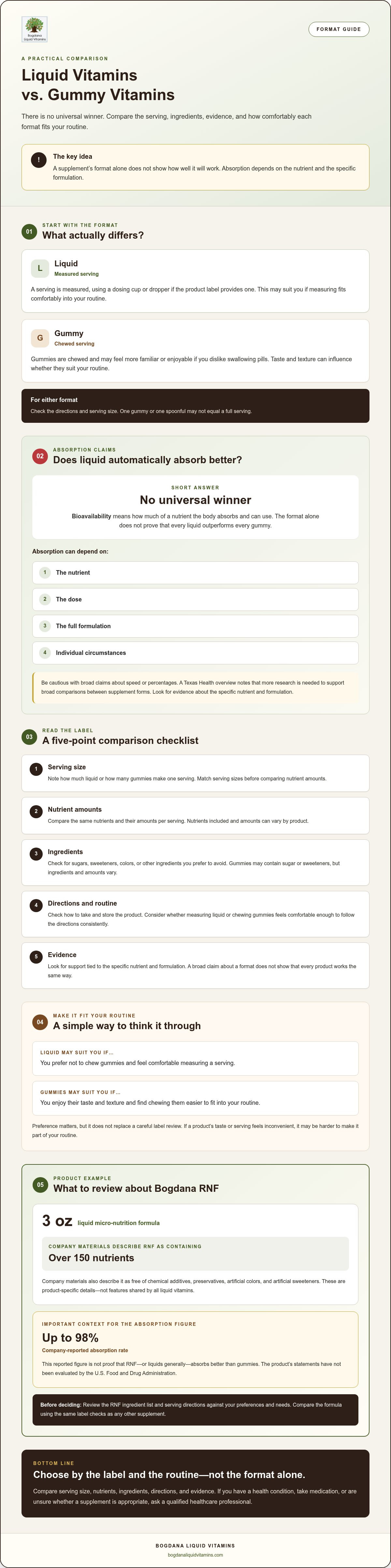
Liquids and gummies offer different ways to take a supplement. A liquid serving is measured using a dosing cup, dropper, or a spoon. Gummies are chewed, which may feel more familiar or enjoyable if you dislike swallowing pills. Multivitamin products come in several forms, including liquids and gummies, as outlined in Multivitamin preparations.
Convenience depends on your preferences. A liquid may suit you if measuring a serving fits your routine; a gummy may be easier to stick with if you enjoy its taste and texture. Neither format is automatically more convenient or suitable for everyone. Check the directions and serving size, since one gummy or one spoonful may not represent a full serving.
Does liquid form automatically mean better absorption?
No. Bioavailability means how much of a nutrient the body can absorb and use. A liquid’s form may affect how it is delivered, but it does not prove that every liquid outperforms every gummy. The nutrient, dose, full formulation, and individual circumstances can all influence absorption. A health-system overview from Texas Health says more research is needed to support broad comparisons between supplement forms.
Be cautious with general claims about absorption speed or percentages. Look for evidence about the specific nutrient and formulation, rather than relying on format alone. The useful question of liquid vitamins vs gummy vitamins is not about which one absorbs better. Consider whether the product’s serving, ingredients, and directions make sense for your needs and routine.
How to Compare Liquid and Gummy Vitamin Labels
Package claims can sound impressive, but the label offers practical details for comparing products. When weighing liquid vitamins vs gummy vitamins, compare the nutrients and serving basis on each Supplement Facts panel. Do not judge by front-label wording alone. First match the serving sizes, then compare the nutrient amounts and ingredients listed for each serving.
A simple checklist for choosing a supplement format
Serving size: Note how much liquid or how many gummies make one serving. Match serving sizes before comparing nutrient amounts.
Nutrient amounts: Compare the same nutrients and their amounts per serving. The nutrients included and their amounts can vary by product.
Ingredients: Review the full ingredient list for sugars, sweeteners, colors, or other ingredients you prefer to avoid. Gummies may contain sugar or sweeteners, but ingredients and amounts vary, so check the label.
Directions and routine: Check how to take and store the product. Then consider whether measuring a liquid or chewing gummies is comfortable enough for you to follow the directions consistently.
Evidence: Look for support tied to the specific nutrient and formulation. A broad claim about a format does not show that every product works the same way.
When assessing a liquid’s absorption claims, focus on evidence for the product and nutrients in question rather than assuming the format guarantees a particular result.
If you have a health condition, take medication, or are unsure whether a supplement is appropriate for you, ask a qualified healthcare professional. They can help you consider your circumstances before you add a supplement to your routine.
Once you know what to look for, you can review Bogdana’s liquid vitamin options and check product details against the same criteria.
Choosing a Liquid or Gummy Vitamin for Your Routine
The best format is one you can take comfortably and as directed. A liquid may work well if you prefer not to chew gummies and feel comfortable measuring a serving. Gummies may feel simpler if you enjoy their taste and texture. In either case, check that the serving size and nutrient amounts match what you are looking for, and follow the product’s directions.
That is the practical side of liquid vitamins vs gummy vitamins: preference matters, but it does not replace a careful label review. If you dislike a product’s taste or find its serving inconvenient, it may be harder to make it part of your routine.
What to review before considering Bogdana RNF
Bogdana RNF is a 3 oz liquid micro-nutrition formula. Company materials describe it as containing over 100 nutrients and as free of chemical additives, preservatives, artificial colors, and artificial sweeteners. These are product-specific details, not features shared by all liquid vitamins. The company also reports an absorption rate of up to 98%. That reported figure is not proof that RNF, or liquids generally, absorb better than gummies. The product’s statements have not been evaluated by the U.S. Food and Drug Administration.
Choose a Supplement Format That Fits Your Day
Choosing between liquid vitamins vs gummy vitamins comes down to more than format. Taste, convenience, serving size, nutrient amounts, and ingredients all matter. Compare labels using the same serving basis, follow product directions, and do not assume liquids or gummies are universally more effective. Choose a format you are comfortable taking consistently and a product that matches your needs.
As one liquid example, Bogdana’s RNF is described by the company as containing over 100 nutrients and as free of chemical additives, preservatives, artificial colors, and artificial sweeteners. Review the ingredient list and serving directions to see whether the formula aligns with your preferences.
Take a moment to compare your options, then explore Bogdana’s liquid vitamin formulas and review the product details to see whether one fits your routine.
Frequently Asked Questions
Are liquid vitamins more effective than gummy vitamins?
Liquid vitamins are not automatically more effective than gummy vitamins. Effectiveness can depend on the nutrients, dose, formulation, and whether the product suits your needs and is taken as directed. Texas Health notes that more research is needed for broad comparisons between supplement forms. Compare equivalent serving sizes and nutrient amounts rather than assuming format alone determines results.
Do liquid vitamins absorb faster than gummy vitamins?
There is not enough evidence to say that liquids always absorb faster than gummies. Bioavailability describes how much of a nutrient the body absorbs and can use, and it can vary with the nutrient and product formulation. A liquid’s format alone does not prove faster absorption. Look for evidence about the specific nutrient and formula, not broad speed claims.
Can gummy vitamins contain added sugar or fewer nutrients?
Some gummy vitamins contain added sugar, and nutrient amounts vary between products. Gummies are not automatically lower in nutrients, though some formulas may include different nutrients or amounts than a liquid. Check the Supplement Facts panel for serving size and nutrient amounts, then review the ingredients for sugars and sweeteners. Do not rely on assumptions based on format.
How do I choose between liquid and gummy vitamins?
When comparing liquid vitamins vs gummy vitamins, review serving size, nutrient amounts, ingredients, and directions, then consider which format’s taste and routine suit you. Choose based on the label and your preferences, not a blanket claim that one form is superior. If you have a health condition, take medication, or have questions about supplements, ask a qualified healthcare professional.
Disclaimer
The above statements have not been evaluated by the Food and Drug Administration.
The products mentioned are not intended to diagnose, treat, cure, or prevent any disease.



Comments