


Immune Health Guide: Vital Nutrient Recommendations

More supplements don’t automatically mean better immune support. If online advice has left you unsure which nutrients matter, or whether to start with food or a formula, you’re not alone. Nutrient recommendations for the immune system are best understood as a guide to meeting your needs, not a reason to take megadoses. The goal is to support normal immune function by avoiding nutrient gaps.
A balanced diet is the foundation, while supplements may help fill a gap when food alone isn’t meeting your needs. The NIH Office of Dietary Supplements explains that vitamins and minerals play important roles in immune function, but more isn’t always better. This guide covers key nutrients, ways to assess your diet, and what to check on a supplement label. It also explains how to consider general-wellness products without mistaking them for medical treatment.
Table of Contents
Which Nutrients Support Normal Immune System Function?
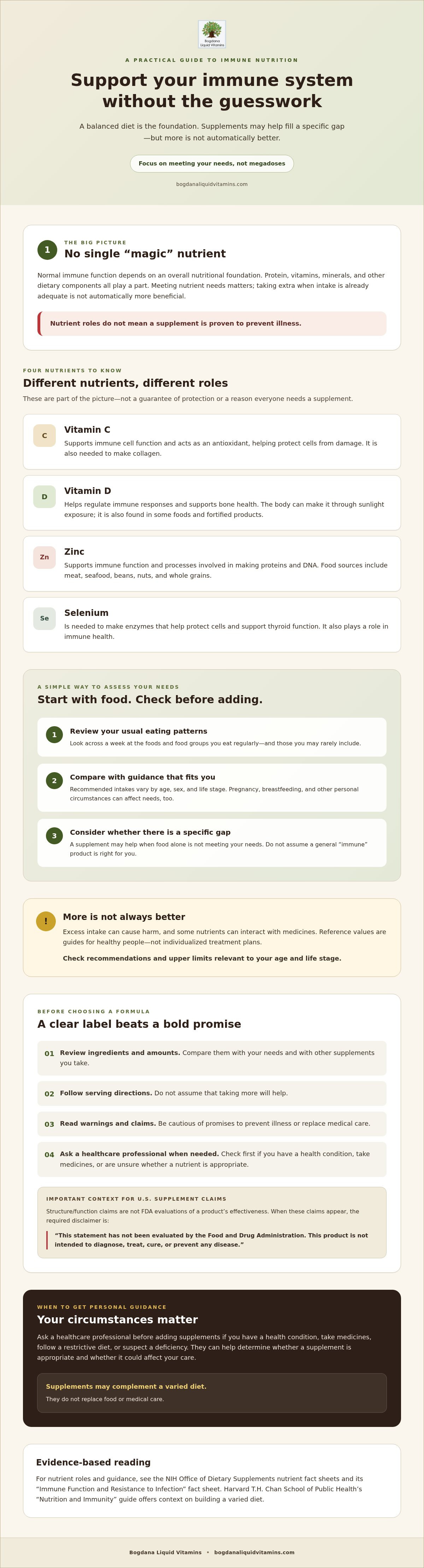
Immune function depends on the body’s overall nutritional foundation, not a single “magic” nutrient. Protein, vitamins, minerals, and other dietary components all play a part. Nutritional immunology explores how diet and immune activity connect, while guidance from the NIH Office of Dietary Supplements explains the roles of specific nutrients.
A nutrient’s role in normal immune function doesn’t mean a supplement is proven to prevent illness. Meeting your needs matters. If your intake is already adequate, taking extra isn’t automatically more beneficial.
What do vitamin C, vitamin D, zinc, and selenium do?
These nutrients support different processes in the body:
Vitamin C supports immune cell function and acts as an antioxidant, helping protect cells from damage. The NIH Office of Dietary Supplements notes that vitamin C is also needed to make collagen.
Vitamin D helps regulate immune responses and supports bone health. The body can make it through sunlight exposure, and it’s also found in some foods and fortified products.
Zinc supports immune function and processes involved in making proteins and DNA. The NIH notes that it’s found in foods such as meat, seafood, beans, nuts, and whole grains.
Selenium is needed to make enzymes that help protect cells and support thyroid function. It also plays a role in immune health.
For more detail, see the NIH’s vitamin C, vitamin D, zinc, and selenium fact sheets. These nutrient recommendations are a starting point, not a reason to assume everyone needs a supplement. For more nutrient and food examples, explore the Best Nutrients for Immunity guide.
How to Meet Immune-Nutrition Needs Without Guesswork
Turn nutrition advice into a practical check rather than a reason to add supplements straight away. Review what you usually eat across a week, compare your intake with trusted guidance, then consider whether a supplement could fill a specific gap. Harvard T.H. Chan School of Public Health’s Nutrition and Immunity guide offers context on building a varied diet.
Review your eating patterns. Notice which foods and food groups you eat regularly, and which you may rarely include.
Check guidance that fits you. NIH dietary reference values vary by age, sex, and life stage. Pregnancy, breastfeeding, and other individual circumstances can affect needs, too.
Assess whether a supplement is needed. Consider your diet and circumstances before choosing a formula. Don’t assume a general “immune” product is right for you.
More than the recommended amount isn’t automatically better. Excess intake can cause harm, and some nutrients can interact with medicines. The NIH Office of Dietary Supplements explains that reference values are guides for healthy people, not individualized treatment plans. Use its nutrient fact sheets to check recommendations and upper limits relevant to your age and life stage.
When should you consider a supplement or ask a clinician?
Ask a healthcare professional before adding supplements if you have a health condition, take medicines, follow a restrictive diet, or suspect a deficiency. They can help determine whether a supplement is appropriate and whether it could affect your care. Supplements may complement a varied diet, but they don’t replace food or medical care. If you’re comparing general-wellness liquid formulas, review liquid vitamin options and check each product’s ingredient list against your needs.
How to Evaluate Immune-Support Supplements Responsibly
A clear label is a more useful starting point than a bold promise. Use this checklist when comparing formulas:
Review the ingredients and amounts. Compare them with your needs and with other supplements you take.
Follow serving directions. Don’t assume taking more will help.
Read warnings and claims. Be cautious of promises to prevent illness or replace medical care.
Ask a clinician when needed. Check first if you have a health condition, take medicines, or are unsure whether a nutrient is appropriate for you.
The NIH’s Immune Function and Resistance to Infection fact sheet provides evidence-based context for nutrient roles. In the United States, supplement structure/function claims aren’t FDA evaluations of a product’s effectiveness. When such claims appear, they must carry this disclaimer: “This statement has not been evaluated by the Food and Drug Administration. This product is not intended to diagnose, treat, cure, or prevent any disease.” Bogdana RNF should not be described as FDA-approved or as preventing illness.
What can readers verify about Bogdana RNF?
Bogdana describes RNF as a general-wellness liquid formula, not an immune treatment. Company materials describe it as containing over 100 nutrients, and a company press release reports an absorption rate of up to 98%. These are company-reported product details, not evidence of an immune-specific effect. The company also describes RNF as free of chemical additives, preservatives, artificial colors, and artificial sweeteners. Review the RNF ingredient list and product information to assess whether it fits your needs and preferences. Nutrient recommendations are about meeting nutritional needs, not finding a guaranteed shortcut. If the formula fits your general-wellness preferences after that review, you can explore the liquid vitamin shop.
Make Your Next Nutrition Choice With Confidence
Nutrient recommendations for the immune system are a guide to meeting your needs, not a reason to chase megadoses. A varied diet is a sensible foundation, while supplements may help address a gap when appropriate. Check a formula’s ingredients, directions, and warnings, and ask a healthcare professional if your health or medicines raise questions.
Bogdana describes RNF as containing over 100 nutrients and reports 16 years of intensive research. These company statements don’t establish an immune-specific effect. Read product claims with this disclaimer in mind: “This statement has not been evaluated by the Food and Drug Administration. This product is not intended to diagnose, treat, cure, or prevent any disease.”
Keep your approach steady and informed. Small, thoughtful choices can support your overall wellness journey.
Frequently Asked Questions
Which nutrients are most important for normal immune system function?
No single nutrient works alone or guarantees protection. The NIH Office of Dietary Supplements suggests vitamins A, C, D, and E, minerals such as zinc and selenium, and protein as important to normal immune function. A varied diet can help provide them. The practical goal is to meet your nutritional needs rather than relying on one “immune-boosting” ingredient.
Can supplements prevent colds or other infections?
Supplements can’t be relied on to prevent colds or other infections. The NIH Office of Dietary Supplements notes that regular vitamin C use doesn’t generally reduce cold risk for most people, though it may modestly shorten a cold. Evidence varies for other nutrients and situations. Supplements may help fill a nutritional gap, but they aren’t a substitute for medical care.
How much vitamin C, vitamin D, zinc, or selenium should adults take?
For generally healthy adults, the NIH Office of Dietary Supplements lists daily recommended amounts of 75 mg of vitamin C for women and 90 mg for men; 15 mcg (600 IU) of vitamin D through age 70 and 20 mcg (800 IU) after 70; 8 mg of zinc for women and 11 mg for men; and 55 mcg of selenium. See the NIH’s vitamin C, vitamin D, zinc, and selenium fact sheets. Needs can vary, so ask a clinician about your circumstances.
What happens if you take more immune-support supplements than recommended?
Taking too much can cause side effects or harm, and risks differ by nutrient. The NIH Office of Dietary Supplements notes that high vitamin C intake may cause digestive upset, while excessive vitamin D can raise blood calcium. Too much zinc can interfere with copper absorption, and excess selenium can damage hair and nails. Check the amounts in all products you use and ask a clinician or pharmacist if unsure.
Disclaimer
The above statements have not been evaluated by the Food and Drug Administration.
The products mentioned are not intended to diagnose, treat, cure, or prevent any disease.



Comments