


Liquid Multivitamin with Minerals: How to Compare Formulas

A liquid format can feel like the easier choice, but it doesn’t tell you whether a formula is a good fit. When comparing a liquid multivitamin with minerals, look beyond the bottle: check which nutrients it contains, how clearly the amounts and serving directions are presented, and what evidence supports its claims. Convenience matters, but so does understanding what you’re taking.
This guide explains what vitamins and minerals do, how to compare nutrient details and formulation claims, and what to consider when weighing liquids against tablets or capsules. It also introduces Bogdana RNF, a liquid formula containing over 100 nutrients, including vitamins, minerals, trace minerals, amino acids, and proteins from natural and organic sources. Use the practical comparison points here to decide whether its broad formula suits your preferences and wellness routine, while keeping absorption claims in perspective.
Table of Contents
What Does a Liquid Multivitamin with Minerals Typically Include?

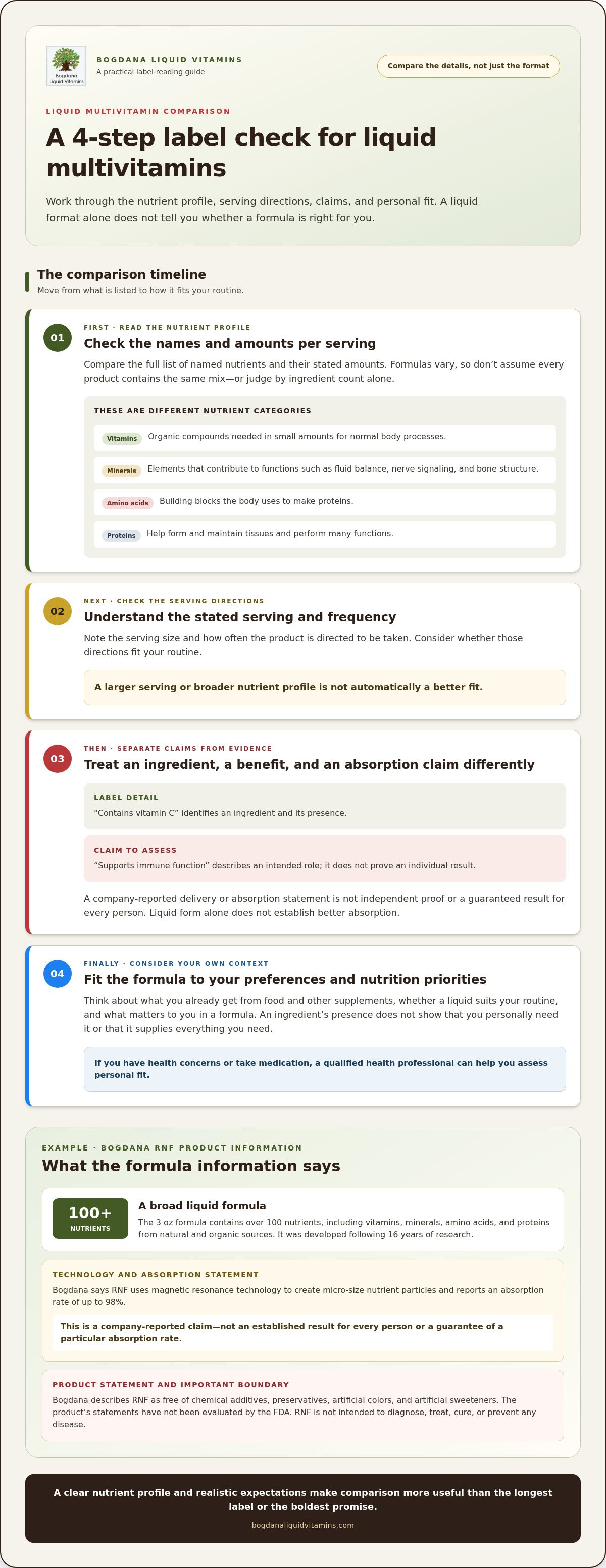
These nutrients are related, but they aren’t interchangeable. Vitamins are organic compounds needed in small amounts for normal body processes. Minerals are elements that contribute to functions such as fluid balance, nerve signaling, and bone structure. Amino acids are building blocks the body uses to make proteins, while proteins help form and maintain tissues and perform many functions. A formula that includes all four categories brings together different types of nutrients, not one uniform ingredient.
How to Read a Multivitamin and Mineral Nutrient Profile
Start by checking the nutrient names and amounts per serving. Then consider statements about what the nutrients do as separate claims. For example, “contains vitamin C” identifies an ingredient, while “supports immune function” describes an intended role. Neither statement proves an individual result. Because formulas vary, compare the full profiles and serving directions rather than expecting every product to contain the same nutrients.
Next, consider what you already get from food and other supplements. An ingredient’s presence doesn’t show that you personally need it, that it will provide a particular benefit, or that the formula supplies everything you need. A clear profile makes comparison easier. For more on liquid-format claims, use a liquid vitamin absorption checklist to keep the details in perspective.
How to Compare a Liquid Multivitamin with Minerals
A fair comparison looks past the front-label promises. Formulas can differ in nutrient selection, amounts, serving directions, and the evidence behind formulation claims. The NIH Office of Dietary Supplements regarding multivitamin/mineral supplements explains how these products vary in composition. Compare the details on each product rather than relying on the category name.
Use this checklist:
Review the full nutrient profile. Note each named nutrient and its amount per serving. Compare like with like, and check the serving size so you’re not judging products by ingredient count alone.
Read the directions. Check the stated serving and frequency, then consider whether they fit your routine. A larger serving or broader nutrient profile isn’t automatically a better fit.
Separate claims from evidence. A company may describe a delivery method or report an absorption rate. Treat that as a company-reported claim, not independent proof or a result guaranteed for every person. Liquid form alone doesn’t establish better absorption.
Which Label Details Help You Make a Fair Comparison?
Look for named ingredients, clear serving directions, and an explanation of how the formula is put together. A stated nutrient amount is a label detail; a promise about what that nutrient will do is a claim to assess separately. Bogdana’s RNF ingredient information lets you examine the formula’s listed components. You can also explore the Bogdana product range for liquid options.
Finally, consider your usual diet, other supplements, and whether a liquid fits your preferences. If you have health concerns or take medication, guidance from a qualified health professional can help you assess personal fit. The goal is to choose with clear information, not simply to pick the product with the longest label.
Is Bogdana RNF a Fit for Your Liquid Multivitamin Preferences?
Bogdana RNF may suit readers who prefer a broad liquid formula rather than selecting separate nutrient categories. This liquid micro-nutrition supplement contains over 100 nutrients, including vitamins, minerals, trace minerals, amino acids, and proteins from natural and organic sources. It was developed following 16 years of research. You can learn more about its development through Bogdana’s development story.
Bogdana reports an absorption rate of up to 98%. This is a company-reported claim, not an established result for every person. Neither a liquid format nor a stated technology guarantees that your body will absorb nutrients at a particular rate. Weigh the claim alongside the ingredient profile, serving directions, and your preferences.
What the RNF Product Information Says, and What It Does Not Claim
Bogdana describes RNF as free of chemical additives, preservatives, artificial colors, and artificial sweeteners. The product’s statements have not been evaluated by the FDA. RNF is not intended to diagnose, treat, cure, or prevent any disease. These boundaries matter: nutrient information and formulation features help explain what a product contains, but they don’t prove a specific health outcome or show that the formula is right for everyone.
If you’re comparing a liquid multivitamin with minerals, review RNF’s stated ingredients and format against your routine and nutritional priorities. The RNF product details provide more information about the formula. Broad nutrient coverage is not a substitute for an individualized assessment.
Make Your Next Wellness Choice with Confidence
Choosing a liquid multivitamin with minerals is a personal decision, not a race to find the longest ingredient list or boldest promise. Focus on what matters to you: a format that suits your routine, ingredients you can understand, and how a supplement fits alongside your everyday nutrition. Clear information and realistic expectations make for a more considered choice.
If Bogdana RNF is on your shortlist, review its product information and compare its approach with your preferences and routine.
Explore Bogdana RNF and its product information to see whether this liquid formula fits your preferences.
Frequently Asked Questions
What is a liquid multivitamin with minerals?
A liquid multivitamin with minerals combines vitamins, minerals, and trace minerals in a liquid serving. Check how the serving is measured and which nutrients the label names. A liquid may suit someone who prefers not to swallow tablets, but the format alone doesn’t show whether the nutrient amounts match personal needs.
Are liquid multivitamins absorbed better than tablets?
Not automatically. Absorption can depend on the nutrients, the formulation, and individual factors, so liquid form alone doesn’t prove an advantage over a tablet. If swallowing tablets is difficult, a liquid may be easier to take consistently. Treat specific absorption percentages as claims to evaluate, not as predictions of your personal experience.
What minerals should a liquid multivitamin include?
There isn’t one required mineral list that suits everyone. Food choices, life stage, and other supplements can affect what's relevant. Rather than choosing a formula by the number of minerals it contains, check the label for named minerals and amounts per serving. This can also help you see which nutrients you already get elsewhere.
Does Bogdana RNF contain minerals as well as vitamins?
Yes. Bogdana RNF contains over 100 nutrients, including vitamins, minerals, and trace minerals, amino acids, and proteins. Review the product’s ingredient information for the specific nutrients and amounts. An ingredient’s presence alone doesn’t establish that you need it or that the formula is right for you.



Comments