


Nutrition for Longevity: An Evidence-Informed Guide

What is a practical nutritional recommendation for longevity? It is usually not a single supplement or “perfect” food, but an eating pattern you can sustain. Conflicting advice and bold product claims can make it hard to tell which choices support healthy aging and which promise more than the evidence can show.
That uncertainty is understandable. Healthy aging is shaped by everyday habits, not a quick fix. This guide covers food-first choices associated with healthy aging, ways to assess supplement claims, and realistic expectations about what nutrition can and can’t do. It also explains how a liquid nutritional formula might fit into a broader wellness routine, with sustainable habits at the center.
Table of Contents
What Does Longevity Nutrition Actually Recommend?
Longevity nutrition is less about finding a secret ingredient and more about building eating habits you can maintain as you age. The aim is to support health, energy, and everyday function over time, not to promise a longer life. A practical nutritional recommendation for longevity starts with an overall pattern of varied, nutrient-rich foods and choices that fit your needs and lifestyle.
The National Institute on Aging encourages healthy eating and supporting well-being as we age. Harvard T.H. Chan School of Public Health also emphasizes overall diet quality, including vegetables, fruits, whole grains, and healthy sources of protein. These broad patterns are a more grounded starting point than claims that one food or nutrient is a shortcut to longevity. For background on how researchers distinguish lifespan from healthspan, see this overview of human longevity.
How to read longevity nutrition evidence without overpromising
Start by checking what a study actually measured. If researchers find that people who follow a particular eating pattern tend to have better health outcomes, that is an association. It does not prove the diet alone caused the outcome. Other factors, such as activity, access to care, or smoking, may also play a role. Harvard T.H. Chan’s nutrition guidance and the National Institute on Aging’s healthy-aging information offer useful context for interpreting broad dietary advice.
Evidence about an overall dietary pattern does not automatically show that one nutrient or supplement produces the same effects. A promising ingredient, a biological explanation, or a product’s nutrient count is not proof that it extends life.
Supporting healthy aging means choosing habits that contribute to well-being; proving a product extends lifespan requires evidence that directly demonstrates that outcome. No single food, nutrient, or supplement guarantees longevity or prevents disease. Look for evidence that matches the claim, and keep expectations realistic.
How to Choose Nutrition and Supplements for Healthy Aging
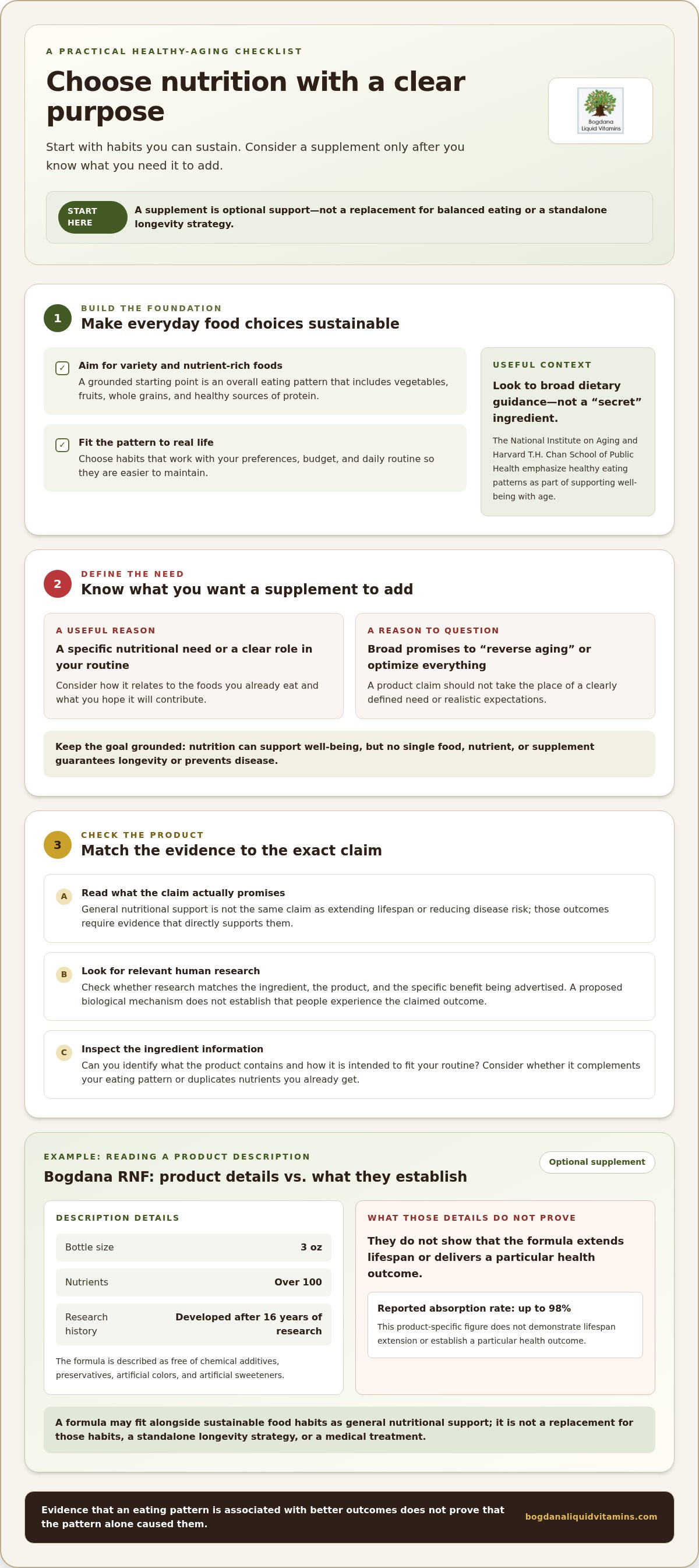
A thoughtful nutritional recommendation for longevity starts with your routine, not a bottle. Use this sequence to decide whether a supplement has a useful role for you:
Build everyday food habits. Aim for a varied eating pattern that includes nutrient-rich foods and works with your preferences, budget, and daily life. Nutrition.gov offers practical, government-backed nutrition information to help you explore balanced eating.
Identify a specific reason. Be clear about what you hope a supplement will add. A defined nutritional need is more useful than a broad promise to “reverse aging” or optimize everything.
Assess the evidence and label. Look for clear ingredient information and research that matches the ingredient, product, and claimed benefit. Supplements can complement a varied eating pattern, but they do not replace it.
Which questions help assess a longevity supplement?
First, examine the claim. Does it describe general nutritional support, or promise to extend lifespan or reduce disease risk? Those claims require different levels of evidence. Look for relevant human research and check whether it supports the specific advertised benefit. A proposed biological mechanism may explain how an ingredient could work, but it does not establish that people experience the claimed outcome.
Ingredient transparency matters, too. Can you identify what the product contains and how it is intended to fit into a routine? Consider whether it complements your eating pattern or duplicates nutrients you already get. A broader comparison of the best longevity supplements can help you explore categories while keeping claims in perspective.
There is no need to rush toward a “perfect” formula. If you are considering liquid nutrition as one optional part of general wellness, you can browse Bogdana’s liquid nutrition products alongside a food-first approach.
Where Bogdana RNF Fits in a Thoughtful Longevity Routine
Bogdana RNF is a liquid micro-nutrition supplement that can be part of a broader wellness routine. It comes in 3 and 9 oz sizes, contains over 100 nutrients, and was developed after 16 years of research. The formula is described as free of chemical additives, preservatives, artificial colors, and artificial sweeteners. These details describe the product, but do not show that it extends lifespan or replaces sustainable food habits.
A sensible nutritional recommendation for longevity keeps everyday choices at the foundation. Harvard T.H. Chan School of Public Health’s healthy longevity guidance focuses on dietary patterns and other lifestyle factors that support health over time. A supplement may fit alongside those habits as general nutritional support, but it is not a standalone longevity strategy or medical treatment.
What the RNF description does, and does not, establish
A nutrient count and research history help describe a formula, but they do not by themselves show that it improves a particular health outcome. Bogdana reports an absorption rate of up to 98%. That product-specific figure does not demonstrate lifespan extension or establish a particular health outcome. Likewise, general wellness language should not be read as evidence of disease prevention.
For a closer look at the formula, review the RNF ingredient list and consider how it relates to your eating pattern and nutritional needs. An informed decision starts with understanding the ingredients, keeping expectations realistic, and deciding whether a liquid formula suits your routine.
Make Your Next Wellness Choice a Sustainable One
Healthy aging is not a finish line reached through one perfect meal or product. It is supported by choices you can return to, even when life gets busy. Make your next step small and practical: identify one habit you would like to strengthen, then give it time to become part of your routine. A nutritional recommendation for longevity is most useful when it works in your real life.
If you are considering liquid nutrition, review the formula details and decide whether they align with your preferences and general wellness goals. An informed choice should feel clear, realistic, and complementary to the habits you are already building.
Keep moving forward with curiosity and consistency. Small, thoughtful steps can help make your wellness routine more grounded and sustainable.
Frequently Asked Questions
What is the best nutrition recommendation for longevity?
There is no single ideal menu for everyone. A practical nutritional recommendation for longevity is an eating pattern you can maintain, with a variety of vegetables, fruits, whole grains, legumes, nuts, and suitable protein sources. For example, build a meal around beans or fish, vegetables, and a whole grain, then adapt the ingredients to your preferences and needs.
Can supplements help you live longer?
Supplements can provide nutrients, but that does not establish that they help people live longer. A supplement may be useful when it addresses a specific dietary gap, yet a claim about lifespan needs direct evidence measuring lifespan, not just a proposed biological effect. Treat longevity promises cautiously and consider whether the product’s ingredients and research support its specific claims.
Are liquid vitamins better for longevity than food?
No form of vitamin has been shown to be inherently better for longevity than food. A liquid may suit someone who prefers that format, but convenience alone does not prove a greater effect on healthy aging. Foods provide components such as fiber and a mix of nutrients. Choose a format that fits your routine. Do not treat it as a replacement for meals.
What should I look for in a longevity supplement?
Look for a clearly stated ingredient list, understandable amounts, and claims tied to relevant human research. Check whether the evidence supports the specific benefit advertised, rather than a different outcome or only a theory about how an ingredient might work. Consider how the formula fits your diet. If you take medication or manage a health condition, discuss supplement use with a healthcare professional.


Comments