


Are Expensive Multivitamins Better? What Price May Tell You

A higher price doesn’t automatically mean a better multivitamin. Whether expensive multivitamins are better depends on what’s in the formula, whether the nutrient forms and doses suit your needs, and how reliably your body can absorb them. Price alone can’t tell you that.
It’s reasonable to expect a premium product to offer something meaningful, especially when you’re choosing nutrients to support everyday health. Here, you’ll learn how to assess quality, compare lower- and higher-priced options, and understand why absorption matters alongside the label. We’ll also look at third-party verification and the roles of nutrients such as vitamin B12, folate, iron, and magnesium, so you can make a more informed choice without assuming that the costliest option is the best fit.
Table of Contents
How can you tell if a vitamin is high-quality?
Quality depends on more than a polished label or premium price. Compare the nutrient forms and amounts, and look for credible quality checks.
Price and Product Quality
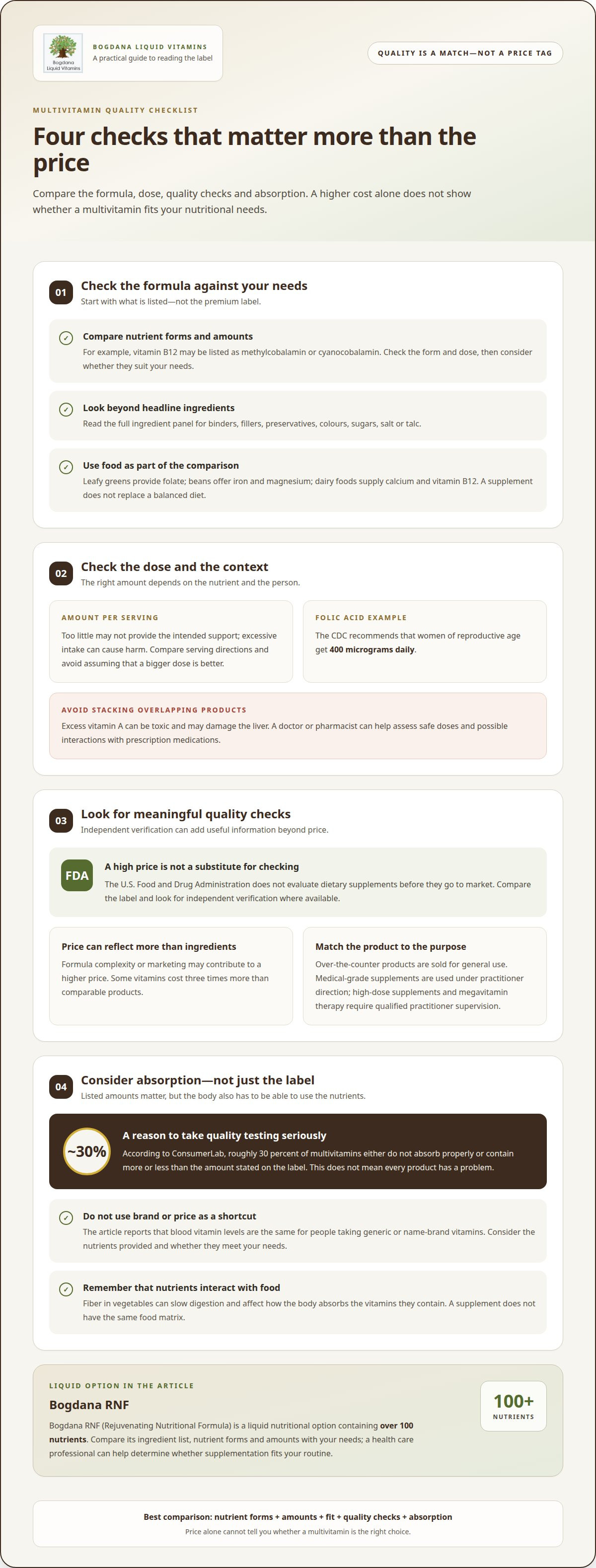
Price is useful only if it reflects a formula that fits your nutritional needs. A higher cost alone doesn’t prove better ingredients or quality. Compare each nutrient’s form and amount with your needs, and look for independent verification where available. The U.S. Food and Drug Administration doesn’t evaluate dietary supplements before they go to market, so a high price is no substitute for reading the label.
Start with food. Leafy greens provide folate, beans offer iron and magnesium, and dairy foods supply calcium and vitamin B12. A health care professional can help identify whether your diet, medications, or life stage make supplementation useful. Personalized vitamin services may assess these details to guide product choices, but the value lies in matching nutrients and doses to an individual, not simply paying more. If a vitamin is unnecessary, a personalized recommendation may also point toward food-first habits.
Dosage and Toxicity Risks
Dosage is the amount of a nutrient in each serving, and the right amount depends on the nutrient and your circumstances. Too little may not provide the intended support, while excessive intake can cause harm. The Centers for Disease Control and Prevention recommends that women of reproductive age get 400 micrograms of folic acid daily. Excess vitamin A can be toxic and may damage the liver, so avoid stacking products with overlapping ingredients. A doctor or pharmacist can help assess safe doses and possible interactions with prescription medications.
What's The Difference Between Cheap And Expensive Vitamins?
Are expensive multivitamins better? Not automatically. A higher price may reflect ingredients, formula complexity, or marketing, but it doesn’t prove a better fit. Medical-grade supplements differ from over-the-counter products in their use and dosage, so the distinction matters when addressing a specific nutritional need.
Medical-Grade and Over-the-Counter Supplements
Medical-grade supplements are used under practitioner direction, while over-the-counter (OTC) products are sold for general use. OTC supplements generally contain lower dosages than medically prescribed supplements. This matters when a clinician addresses a diagnosed need: a high-dose product isn’t simply a premium store-bought multivitamin. High-dose supplements and megavitamin therapy should be used only under qualified practitioner supervision.
Ingredient Quality, Forms, and Fillers
Ingredient quality depends on nutrient forms, amounts, and other ingredients in the formula. Vitamin B12, for example, comes as methylcobalamin or cyanocobalamin, so compare the listed form as well as the dose. Supplements may also contain binders, fillers, preservatives, colours, sugars, salt, or talc. The ingredient panel helps reveal what the formula contains beyond its headline claims.
Effectiveness in Preventing Nutrient Deficiencies
Are expensive multivitamins better at preventing nutrient deficiencies? Not simply because they cost more. A useful formula needs to provide the nutrient a person needs in an appropriate dose. An analysis involving 450,000 people found multivitamins didn’t reduce heart disease or cancer risk. A 12-year study of 5,947 men found multivitamin use didn’t reduce mental decline risk. Those findings concern broad health outcomes, not treatment of a diagnosed deficiency.
Multivitamin Prices in the United States
U.S. multivitamin prices vary, and cost alone can’t establish quality. Some vitamins cost three times more than comparable products, with marketing campaigns as one possible reason. Alongside serving size, nutrient forms, and amounts, consider whether liquid vitamin options suit your preferred format.
Nutrient absorption
Absorption describes how nutrients move from food or supplements into the body for use. A multivitamin’s listed amounts matter, but so does how the product releases nutrients during digestion. A premium label can’t guarantee absorption. Compare what the label lists with what you actually need.
According to ConsumerLab, roughly 30 percent of multivitamins either don’t absorb properly or contain more or less than the amount stated on the label. That finding makes quality testing relevant to absorption, not just ingredient lists. It doesn’t mean every product has a problem, but it shows why label claims alone can’t establish how much your body receives.
Brand name and price aren’t reliable shortcuts either. Blood vitamin levels are the same for people taking generic or name-brand vitamins. The benefits of each supplement depend on the nutrients it provides and how well the body uses them, rather than branding alone. Compare the product’s stated amounts and serving directions, and consider whether it supplies nutrients you need.
Food offers another useful comparison. Fiber in vegetables can slow digestion and affect how the body absorbs the vitamins they contain. This illustrates how nutrients interact within a meal rather than in isolation. Vegetables provide fiber and vitamins, while a supplement doesn’t contain the same food matrix. Consider your overall diet alongside a supplement’s label.
Bogdana Liquid Vitamins
Bogdana Liquid Vitamins offers liquid nutritional options for young adults, women, men, and seniors. These may suit readers considering a broader formula rather than judging quality by price alone. Bogdana RNF/Rejuvenating Nutritional Formula contains over 100 nutrients and is presented as One Product for Overall Health. A broad formula may be worth exploring when you want multiple nutrients in one liquid product, while your needs and any advice from a health care professional should guide whether supplementation fits your routine.
To assess the contents, compare the listed ingredients with the nutrient forms and amounts relevant to your needs. The RNF ingredient list can help you make an informed comparison. A supplement doesn’t replace a balanced diet.
To learn more about these liquid vitamin options, contact Bogdana Liquid Vitamins.
Choose a Formula That Fits Your Next Step
Whether expensive multivitamins are better depends on how well a formula fits your nutrition priorities and daily routine, not on its price tag. Before choosing, identify which nutrients you want to support, such as vitamin B12, folate, iron, or magnesium, and consider which ones your meals already contain. If you take prescription medication or have a specific health concern, discuss supplement choices with a health care professional. A clearer sense of your needs can make the next comparison more useful and help you focus on a formula that feels practical to take consistently.
Take your time, stay curious, and choose with your everyday well-being in mind.
Frequently Asked Questions
Is There Really Any Benefit to Multivitamins?
Multivitamins may help fill a nutrient gap, but they aren’t necessary for everyone. Their value depends on your diet, health circumstances, and which nutrients you may be missing. For example, someone avoiding several food groups may have different needs from someone eating a varied diet. A healthcare professional can help assess your needs, including how medications or life stage may affect supplement choices. Supplements complement a balanced diet and healthy lifestyle; they don’t replace either.
Why Are Some Vitamins and Supplements More Expensive Than Others?
Price can reflect formula complexity, nutrient amounts, serving size, packaging, or marketing. Compare the nutrients supplied and the cost per labeled serving rather than judging by bottle price alone, then consider whether the ingredients match your needs. A more elaborate formula isn’t automatically better value if it includes nutrients you don’t need.
Do expensive multivitamins contain better ingredients than cheaper ones?
Not necessarily. A higher price is not proof that a multivitamin uses better nutrient forms or more suitable amounts. Compare the ingredient panel and serving directions, then consider which nutrients you’re trying to obtain. A broad formula, for instance, may not suit you better than a simpler one if you’re addressing a specific nutrient gap.
What quality certifications should you look for in a multivitamin?
A USP or NSF mark can provide a third-party quality signal. ConsumerLab.com is among the independent organizations identified as supplement testers. These checks may help you assess product quality, but they don’t show that a multivitamin will prevent illness or meet everyone’s nutritional needs.
Are expensive multivitamins tested for purity and potency?
Price alone doesn’t tell you whether a product has been independently tested for purity or potency. The U.S. Food and Drug Administration doesn’t evaluate dietary supplements before they go to market. A USP or NSF mark provides an independent quality signal, but product testing doesn’t establish whether a supplement suits your needs.


