


High-Potency Liquid Multivitamin: What to Look For

Could a bottle labeled “high potency” still be the wrong fit? A high-potency liquid multivitamin may sound like a straightforward way to get more nutritional support, but potency describes nutrient amounts, not whether the full formula suits your needs. Under the FDA’s labeling definition, a multivitamin and mineral product must provide at least 100% of the Reference Daily Intake for at least two-thirds of the vitamins and minerals it contains.
It’s easy to focus on the numbers, especially when ingredient panels are hard to compare. But the whole formulation matters. Review the amounts per serving, the ingredient information, and the evidence behind product claims. If you take other supplements, also consider how their nutrients add up. The guidance below offers a practical way to compare a liquid multivitamin without treating a potency claim as a measure of overall quality.
Table of Contents
What Does High Potency Mean in a Liquid Multivitamin?
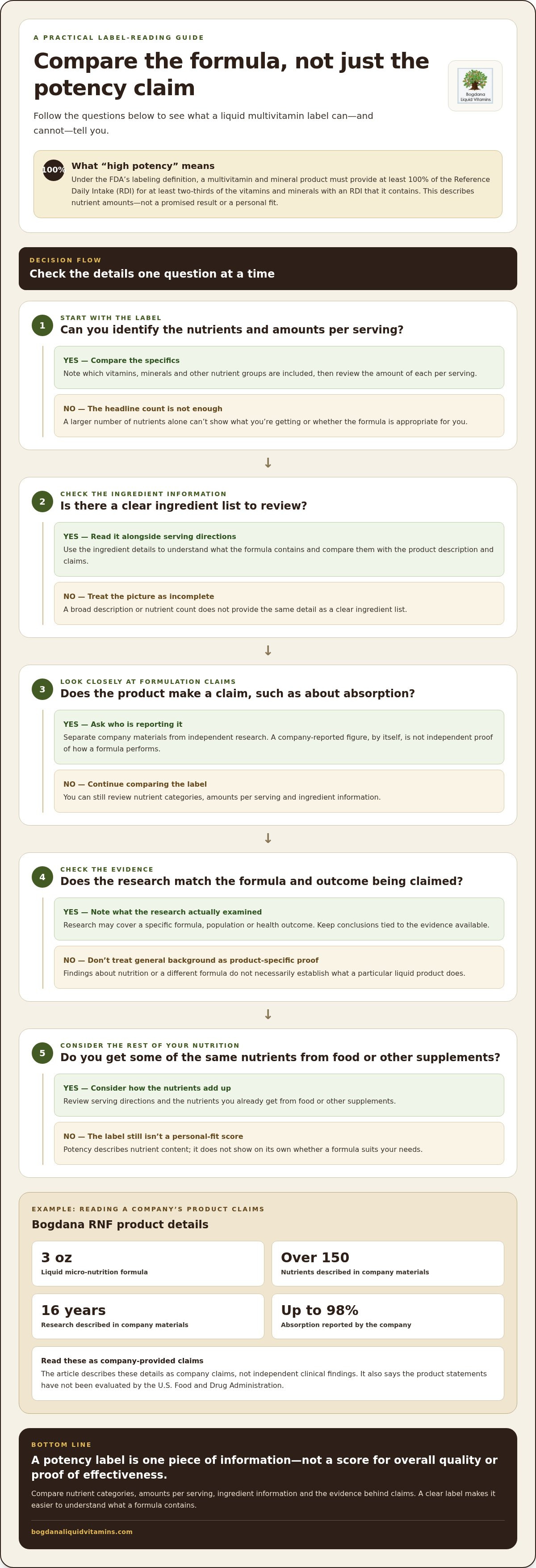
Potency describes how much of a nutrient a serving provides. It doesn’t mean that a formula will be effective or suitable for every one. Under the FDA’s labeling standard, a multivitamin and mineral supplement can be called “high potency” when it provides at least 100% of the Reference Daily Intake (RDI) for at least two-thirds of the vitamins and minerals it contains. The standard concerns nutrient amounts, not a promised health result.
That distinction matters when you compare a liquid multivitamin. The label term can help describe the formula, but it can’t tell you whether the product meets your needs. For background on multivitamin types and research, see this Multivitamin overview.
Does a higher nutrient count always mean a better multivitamin?
Not neccessaraly. The number of nutrients doesn’t automatically mean better quality, greater usefulness, or a better personal fit. Look beyond the headline count to see which nutrients are included and how much the serving provides. Without those details, the total count alone can’t tell you what you’re getting or whether the formula is appropriate for you.
Separate product descriptions from evidence, too. A company’s explanation of its formula or a product claim is not the same as independent scientific evidence that the product produces a particular outcome. Research on multivitamins may examine specific formulas, populations, or health outcomes, so broad findings don’t necessarily apply to every liquid product. Treat potency as one piece of label information, not a score for overall quality or proof of effectiveness.
How to Compare a High-Potency Liquid Multivitamin
Use the label and supporting information together. When comparing a high-potency liquid multivitamin, review these four areas:
Nutrient categories: Note which vitamins, minerals, and other nutrient groups the formula includes, then check the amount of each per serving.
Ingredient information: Look for a clear list that helps you identify what the formula contains instead of relying on a headline nutrient count.
Formulation claims: Pay attention to statements about features such as absorption, and note whether they come from company materials.
Evidence quality: Check whether research concerns the specific formula and outcome being claimed, or provides general background on nutrition.
When comparing products, also consider serving directions and whether you already get some of the same nutrients from food or other supplements. An absorption percentage reported by a company describes its product materials. By itself, it isn’t independent proof of how the formula performs. For example, Bogdana product materials report up to 98% nutrient absorption. Treat that as a company-reported figure unless independent research directly evaluates the same formula. The NIH Office of Dietary Supplements offers broader, evidence-based context in its Choosing a Multivitamin/mineral fact sheet. For general nutrition statements, use reliable scientific sources and avoid drawing product-specific conclusions from research on a different formula.
What should you check on a liquid multivitamin’s ingredient information?
A detailed ingredient page makes it easier to understand what’s in a formula and compare its contents with the product description. Bogdana’s RNF list of ingredients provides details about the formula. Read them alongside the serving directions and product claims, rather than assuming a broad description tells the whole story.
You can also explore Bogdana liquid vitamin formulas and review their product information.
Bogdana RNF: A High-Potency Liquid Formula to Consider
Bogdana RNF is a 3 oz liquid micro-nutrition formula to consider when comparing a high-potency liquid multivitamin. Company materials describe it as containing over 100 nutrients, including vitamins from natural and organic sources, minerals, amino acids, and proteins. They also report 16 years of intensive research, use of magnetic resonance technology to create micro-sized nutrient particles, and up to 98% nutrient absorption. These are company-provided product claims, not independent clinical findings.
“High potency” has a specific meaning in FDA supplement labeling guidance. The definition concerns nutrient amounts. It does not mean the FDA has evaluated or endorsed a particular product. Read the official FDA definition of high potency for context.
How to review the RNF’s stated formulation details
Start with the product information to see what the company says about the formula, then consider what evidence supports each claim. The company describes the nutrient categories and magnetic resonance technology in its materials. The reported absorption figure should likewise be understood as a company statement, not independently verified proof of an outcome. Product materials also describe RNF as free of chemical additives, preservatives, artificial colors, and artificial sweeteners.
Explore the Bogdana RNF 3 oz formula to review its product information. Statements about the product have not been evaluated by the U.S. Food and Drug Administration. RNF is a nutritional supplement, not a medical treatment.
Choose Your Formula with Confidence
Assess a high-potency liquid multivitamin by more than its potency label or nutrient count. Review amounts per serving, ingredient information, and the evidence behind formulation claims. Consider how the product fits with your overall nutrition and any other supplements you take. Clear product information makes it easier to compare formulas and make an informed choice.
Bogdana RNF is a liquid formula to explore. Company materials describe the 3 oz formula as containing over 100 nutrients and report 16 years of intensive research. They also describe it as free of chemical additives, preservatives, artificial colors, and artificial sweeteners. These statements have not been evaluated by the U.S. Food and Drug Administration.
Review the RNF product details and explore Bogdana’s liquid vitamin formulas.
Frequently Asked Questions
Is a high-potency liquid multivitamin better than a regular multivitamin?
Not necessarily. A high-potency liquid multivitamin may provide higher amounts of certain nutrients, but that alone doesn’t make it a better fit for everyone. Compare amounts per serving and the full ingredient information, and consider nutrients you may already get from food or other supplements. More isn’t automatically better, and excessive intake of some nutrients can pose risks.
How can I compare liquid multivitamin absorption claims?
Check who makes the claim and what evidence supports it. A company-reported absorption figure is a product claim, not independent confirmation. More directly relevant evidence would come from research that examines the same formula and explains how absorption was assessed. For example, Bogdana product materials report up to 98% nutrient absorption. Consider that a company-reported figure, not an independently established result.
Can a liquid multivitamin replace a balanced diet or medical care?
No. A liquid multivitamin is a supplement, not a substitute for a varied diet or medical care. It also shouldn’t be used to diagnose, treat, cure, or prevent disease. If you take medications or several supplements, or have questions about your nutrient needs, discuss your situation with a healthcare professional before adding a high-potency formula.
Disclaimer
The above statements have not been evaluated by the Food and Drug Administration.
The products mentioned are not intended to diagnose, treat, cure, or prevent any disease.



Comments