


Liquid vs. Pill Vitamins Absorption: What Science Actually Says

What if the best vitamin form isn’t the one that promises the fastest absorption, but the one that fits your needs and contains the nutrients you’re looking for? It’s understandable to wonder whether liquid vitamins work better than pills. The answer to liquid vs pill vitamins absorption is nuanced: a liquid may bypass the tablet-breakdown step, but that alone doesn’t prove your body absorbs more.
Bioavailability describes how much of a nutrient is absorbed and available for the body to use. It varies by nutrient and formulation. Vitamin B12, vitamin D, iron, zinc, trace minerals such as selenium, and omega-3 fatty acids each have different properties. In this article, you’ll learn what affects absorption, how liquid and pill forms differ, and how to choose a practical option without assuming one is universally superior. We’ll also look at Bogdana RNF, a liquid multi-supplement containing over 100 nutrients. Supplements are not a substitute for food or a well-balanced diet. Talk with a healthcare provider before starting a supplement routine.
Table of Contents
Liquid vs. pill vitamins absorption: what does absorption really mean?
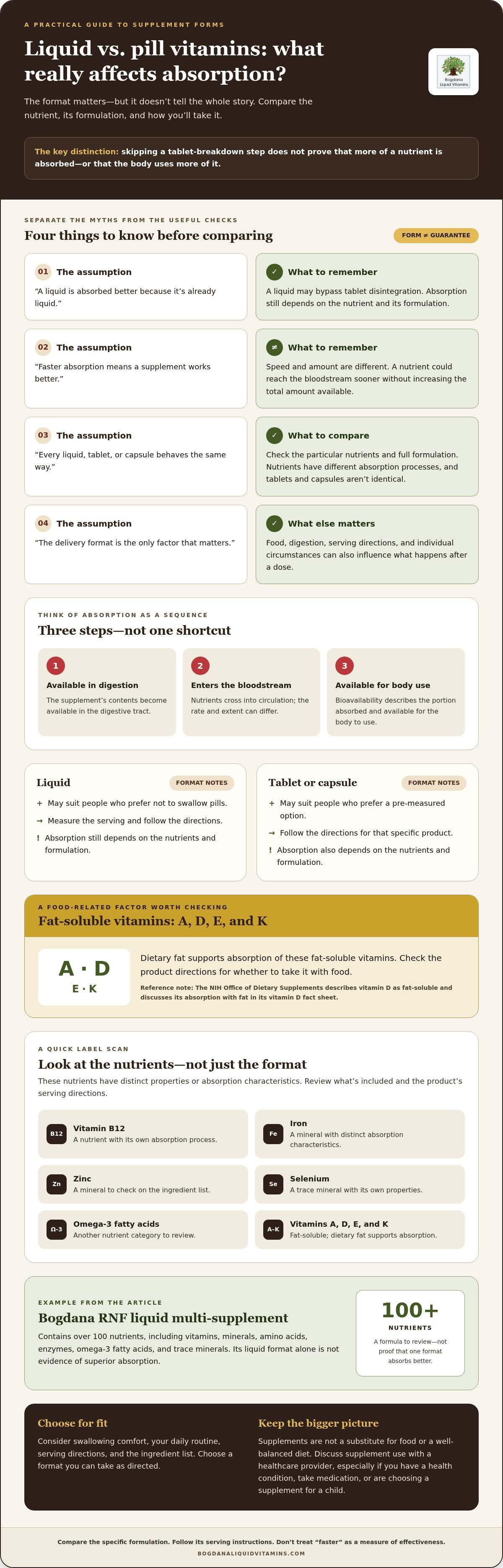
A liquid form alone doesn’t establish better absorption or better results. To compare liquid vs. pill vitamins absorption, separate three steps: a supplement’s contents becoming available in the digestive tract, nutrients crossing into the bloodstream, and the body using them. A liquid may skip a tablet’s disintegration step, but that doesn’t show how much of each nutrient enters circulation or how the body uses it.
Bioavailability describes the portion of a nutrient that is absorbed and available for the body to use. The bioavailability of dietary supplements depends not just on delivery form, but also on the nutrient and its formulation. For example, Vitamin B12 and iron, have distinct absorption processes. A liquid format doesn’t make those processes identical or guarantee better absorption.
Does faster absorption mean a vitamin works better?
Not necessarily. Speed and amount are different questions: a nutrient might reach the bloodstream sooner without increasing the total amount that becomes available. A slower process doesn’t automatically mean less overall absorption, either. Formulation, digestion, food, and the nutrient itself can all influence what happens after a dose is taken.
In pharmacokinetic terms, absorption rate describes how quickly a substance enters systemic circulation, while bioavailability describes the rate and extent to which it does so. These are related but distinct measures (see the general definition of bioavailability). That distinction matters for vitamins such as C and D, minerals such as zinc and selenium, and other nutrients including omega-3 fatty acids. A label’s nutrient list or a liquid texture alone can’t tell you how much your body will ultimately use. Compare the specific formulation and follow its serving instructions rather than treating “faster” as a measure of effectiveness.
How to compare liquid and pill vitamins for absorption
Compare more than the dosage form. Liquids can be easier to swallow, while tablets and capsules may suit people who prefer a pre-measured option. Neither format guarantees better absorption. The nutrients and their formulation matter, too.
Food can matter as much as format. Vitamins A, D, E, and K are fat-soluble, so dietary fat supports their absorption. The NIH Office of Dietary Supplements describes vitamin D as fat-soluble and discusses its absorption with fat in its vitamin D fact sheet. Follow the product’s instructions about taking it with food.
Which factors matter more than the supplement format?
Look at the nutrient forms and the full formulation, then consider food, digestion, and your individual circumstances. Iron, zinc, and selenium are minerals with different absorption characteristics; omega-3 fatty acids belong to another nutrient category. Don’t assume every tablet behaves like every capsule or that all liquids perform the same way. A liquid vs pill vitamins absorption comparison is most useful when it considers the specific nutrients and directions. The Bogdana RNF liquid formula is one example of a liquid multi-supplement containing over 100 nutrients, including vitamins, minerals, amino acids, and omega-3 fatty acids. The liquid format may not necessarily provide better absorption. Discuss supplement use with a healthcare provider, especially if you have a health condition.
Choosing liquid or pill vitamins: match the form to your needs
The best choice is the one that suits your needs and that you can take as directed. Consider swallowing comfort, your daily routine, serving instructions, and the ingredient list rather than assuming the format determines how well a supplement works. If you take medication, have a health condition, or are not sure whether you need a supplement, discuss it with a healthcare provider. It’s especially important to consult a provider before giving a supplement to a child.
Comfort: A liquid may be easier if swallowing pills is difficult. Pills may feel simpler if you prefer a pre-measured serving.
Routine: Choose a format you can consistently fit into your day.
Label: Check the nutrients, serving directions, and whether the instructions specify taking it with food.
When can a liquid multi-supplement be a practical option?
A liquid can be a convenient non-pill option for adults who prefer it or find tablets and capsules uncomfortable to swallow. Bogdana RNF is a liquid multi-supplement containing over 100 nutrients, including vitamins, minerals, amino acids, enzymes, omega-3 fatty acids, and trace minerals. It is designed as a highly absorbable liquid formula. The ingredient range makes it an option to review, not evidence that liquids are absorbed better than pills. The Bogdana RNF ingredient list shows the nutrient groups in the formula.
Follow the product’s serving instructions, and consider overlapping ingredients before adding another supplement. Dietary supplements are not a substitute for food and should not replace a well-balanced diet. They also don’t replace regular exercise, doctor visits, or medical advice. Check with a healthcare provider before adding a supplement to your routine, especially if you have a health condition or are considering a supplement for a child. If a liquid format fits your preferences, explore the liquid formula and compare its ingredients and directions with your needs.
Choose a supplement routine that feels right for you
Make your choice based on your needs, not a blanket promise about one format. Consider which nutrients you’re looking for, how the serving directions fit your day, and whether you’ll feel comfortable taking the supplement consistently. If you’re considering a supplement for a specific health concern or take medication, bring the product label to your healthcare provider and discuss whether it’s appropriate for you.
The question of liquid vs pill vitamins absorption is a starting point, not the whole decision. A thoughtful choice takes your routine, the formula, and professional guidance into account. Bogdana RNF offers a liquid option for people who prefer not to take pills. Dietary supplements should not be a substitute for food or a well-balanced diet, and they do not replace regular exercise or doctor visits.
Frequently Asked Questions
Are liquid vitamins absorbed faster than pills?
A liquid may skip the tablet-breakdown step, but that doesn’t guarantee it reaches the bloodstream faster. Absorption also depends on the nutrient, formulation, and digestion. Capsules can differ from compressed tablets, too. “Faster” alone doesn’t show that you’ll absorb more or notice a different effect, so don’t use speed as the only measure when comparing supplements.
Do liquid vitamins have higher bioavailability than tablets?
Not automatically. For liquid vs. pill vitamins absorption, the specific nutrient and formulation matter more than a simple liquid-versus-tablet label. A liquid’s appearance doesn’t establish how much vitamin B12, iron, or zinc your body can use. Compare the nutrient forms, serving directions, and amounts, and ask a healthcare provider whether a supplement fits your needs, especially if you’re concerned about a possible deficiency.
Can liquid vitamins be a good option if I have trouble swallowing pills?
Yes. A liquid can be a practical alternative if swallowing tablets or capsules makes taking a supplement difficult. Check if you can measure and take the serving as directed, and review the ingredients just as you would for a pill. If swallowing difficulties are ongoing, or you have a health condition or take medication, consult your healthcare provider before changing your supplement routine.
Should I take liquid or pill vitamins with food?
Follow the specific product’s directions, since instructions can differ by nutrient and formulation. Fat-soluble vitamins A, D, E, and K are generally best taken with food that contains some fat. The NIH Office of Dietary Supplements notes that fat helps vitamin D absorption in its vitamin D fact sheet. If you take medication or have questions about timing, check with your healthcare provider.
Explore Bogdana RNF to review the liquid formula and its nutrient profile.


Comments